ПЕРЕВОД СТАТЬИ
Ха лахма анья — «Вот хлеб бедности»
Ha Lachma Anya
Авторы английской Википедии; перевод — Джанидея, с помощью ИИ · 2026-09-13
Полный перевод статьи о пасхальном седере: обряд, история и толкования; оригинал рядом, примечания и лицензированная иллюстрация.
Изображения из источника
Полный перевод
«Ха лахма анья» («Вот хлеб бедности — “страдания”») — возглашение, которое произносят в начале части пасхального седера, называемой «Магид». Этот арамейский текст служит первым объяснением назначения мацы во время седера [1].
История
Хотя отдельные части Агады цитируют Тору, исследователи относят возникновение Агады к талмудической эпохе [2][3]. В частности, они выделяют две основные ранние версии: версию Эрец-Исраэль и вавилонскую [2]. Современные Агады основаны на вавилонской версии; её самые ранние полные копии находятся в сидурах раввинов Амрама Гаона и Саадии Гаона [4]. Со временем появились ашкеназские, сефардские и мизрахские варианты, однако «основной текст Агады сравнительно мало различается у потомков вавилонских версий» [5].
Согласно сочинению раввина Яакова Лорбербаума «Маасе ниссим», «Ха лахма анья» впервые произнесли после разрушения Второго храма в Иерусалиме; согласно Маймониду, до разрушения Храма этот текст не произносили [6]. «Шибболей ха-лекет» утверждает, что «Ха лахма анья» было установлено в Израиле, тогда как Мальбим и Раавья возводят его происхождение к Вавилонии [7]. Дэвид Арноу отмечает, что одни источники относят его возникновение к эпохе гаонов, примерно 750–1038 годам н. э., а другие — уже к I или II веку н. э. [8]. Некоторые средневековые Агады добавляли в начало «Ха лахма анья» фразу «мы вышли из Египта в спешке» (biv’hilu yatsanu m’mitsrayim) [8].
В некоторых Агадах сказано K’Ha Lachma или Ha K’Lachma [9] — «Это подобно хлебу бедности — “страдания”»: так подчёркивается, что маца на седере лишь воспроизводит хлеб, который израильтяне ели в Египте. Профессор Дэвид Даубе предполагает, что слова «Это хлеб» могли быть ошибочно восприняты как намёк на христианское учение о пресуществлении, поэтому в некоторых текстах их изменили на «Это подобно хлебу» [10].
Порядок произнесения
Во время части пасхального седера «Магид» участники пересказывают историю Исхода из Египта [11]. Магид начинается с того, что мацу на столе седера раскрывают, поднимают и произносят «Ха лахма анья» [12][13]. Текст написан на арамейском языке [14] и начинается провозглашением: «Вот хлеб страдания, который наши предки ели в Египте» [15]. Это возглашение основано на Второзаконии 16:3: «Ешь пресный хлеб, хлеб “они” — бедствия, ибо ты вышел из земли Египетской в спешке». Оно служит «первым прямым объяснением мацы в Агаде» [1].
Приглашение гостей
Абраванель учит, что «Ха лахма анья» следует произносить у входа в дом, при открытой двери, чтобы бедняки могли услышать приглашение и войти [6]. Сол Шарфстайн также отмечает, что в прошлом глава семьи выходил на улицу, чтобы произнести «Ха лахма анья» и тем самым пригласить бедных присоединиться к его седеру [16].
Современные толкования
Анисфельд, Мор и Спектор предполагают, что «Ха лахма анья» придаёт рассказу об Исходе «ощущение непосредственности и неотложности», а его произнесение «устанавливает тесную связь с древними израильтянами»: участники седера будут «есть тот же хлеб, который ели они», и «ощутят вкус и осязаемую сторону их рабской жизни» [15]. Цион и Дишон также предполагают, что упоминание мацы в «Ха лахма анья» — «память не об освобождении, а о рабстве» [1]. Айзекс и Шарфстайн отмечают, что начало Магида с рассматривания мацы служит «зримым напоминанием о событиях в Египте», а «Ха лахма анья» «подчёркивает также важность открывать свой дом бедным и делиться с ними пищей: именно через такую щедрость можно стремиться к избавлению» [14][16].
Полный текст возглашения
| Арамейский [17] | Транслитерация [18] | Русский перевод английского столбца [19] |
|---|---|---|
| הָא לַחְמָא עַנְיָא דִי אֲכָלוּ אַבְהָתָנָא בְּאַרְעָא דְמִצְרָיִם. כָּל דִכְפִין יֵיתֵי וְיֵיכֹל, כָּל דִצְרִיךְ יֵיתֵי וְיִפְסַח. הָשַׁתָּא הָכָא, לְשָׁנָה הַבָּאָה בְּאַרְעָא דְיִשְׂרָאֵל. הָשַׁתָּא עַבְדֵי, לְשָׁנָה הַבָּאָה בְּנֵי חוֹרִין. | Ha lachma anya di achalu avhatana b’ara d’mitzrayim. Kol dichfin yeitei v’yeichol, kol ditzrich yeitei v’yifsach. Hashata hacha, l’shanah habaah b’ara d’Yisrael. Hashata avdei, l’shanah habaah b’nei chorin. | Вот хлеб бедности («страдания»), который наши предки ели в земле Египетской. Пусть все голодные войдут и едят; пусть все нуждающиеся войдут и празднуют Песах. В этом году мы здесь, а в будущем году пусть будем в Земле Израиля. В этом году мы рабы, а в будущем году пусть будем свободными людьми. |
Подписи к иллюстрациям оригинала
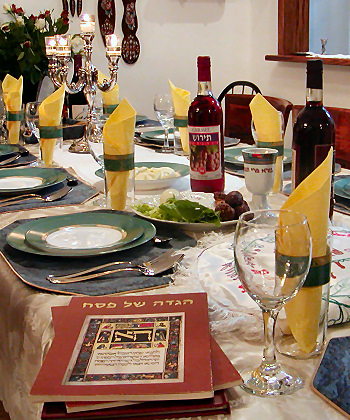
- Во время пасхального седера (на снимке — стол седера) Магид начинается с раскрывания и поднятия мацы и произнесения «Ха лахма анья».
- Исторические примеры «Ха лахма анья»: в Сараевской Агаде, 1350 год н. э.
- В Барселонской Агаде XIV века.
- В Агаде Ротшильда, 1450 год н. э.; использован вариант «Ха ке-лахма анья».
- В «Сестринской Агаде», XIV век.
См. также
- Афикоман
- Ма ништана
Примечания
Библиографические названия и реквизиты сохранены на языке оригинала. Содержательные цитаты из примечаний переведены отдельно ниже.
[1] Zion 1996, p. 37.
[2] Tabory 2008, p. 2.
[3] Telushkin 2001, p. 643.
[4] Tabory 2008, pp. 2–3.
[5] Tabory 2008, p. 3.
[6] Vilosky 2014, p. 55.
[7] Vilosky 2014, p. 54.
[8] Arnow 2008, p. 135.
[9] "Let's make this year different from all other years - The Jewish Chronicle". 21 March 2013.
[10] "Like the bread of affliction". OzTorah. Retrieved March 22, 2018.
[11] "A Review of the Seder of the Seder". Orthodox Union. February 18, 2014. Retrieved April 7, 2016. Over the matza and the second cup of wine, we tell of the Exodus in answer to children's questions.
[12] Scharfstein 1999, p. 81.
[13] Isaacs 2000, pp. 82–83.
[14] Isaacs 2000, p. 83.
[15] Anisfeld 2006, p. 81.
[16] Scharfstein 1999, pp. 81–82.
[17] "פרשני ההגדה - הא לחמא עניא – ויקיטקסט".
[18] Magid Ariel Benjamin
[19] "Archived copy" (PDF). Archived from the original (PDF) on 2019-03-22. Retrieved 2019-03-22.
Перевод цитаты в примечании [11]: «Над мацой и второй чашей вина мы рассказываем об Исходе, отвечая на вопросы детей». Название арамейского текста в [17]: «Толкователи Агады — Ха лахма анья — Викитека».
Библиография
Anisfeld, Sharon Cohen; Mohr, Tara; Spector, Catherine (2006). The Women's Seder Sourcebook: Rituals & Readings for Use at the Passover Seder. Jewish Lights Publishing. ISBN 1580232329.
Arnow, David (2008). My People's Passover Haggadah: Traditional Texts, Modern Commentaries, Volume 1. Jewish Lights Publishing. ISBN 978-1580233545.
Isaacs, Ronald H. (2000). Every Person's Guide to Passover. Jason Aronson. ISBN 0765760436.
Scharfstein, Sol (1999). Understanding Jewish Holidays and Customs: Historical and Contemporary. KTAV Publishing House. ISBN 0881256269.
Tabory, Joseph (2008). The JPS Commentary on the Haggadah: Historical Introduction, Translation, and Commentary. Jewish Publication Society. ISBN 978-0827608580.
Telushkin, Rabbi Joseph (2001). Jewish Literacy. Harper Collins. ISBN 0688085067.
Vilosky, Rabbi Chagai (2014). Pesach Haggadah: The Answer Is... (PDF). Art Scroll. ISBN 9781422614839.
Zion, Noam; Dishon, David (1996). Haggadah Shel Pesach: The Family Participation Haggadah: a Different Night. Shalom Hartman Institute.
Оригинал · en
Читать оригинал для сверки
Ha Lachma Anya ("This is the bread of poverty ("affliction")") is a declaration that is recited at the beginning of the Magid portion of the Passover Seder. Written in Aramaic, the recitation serves as the first explanation of the purpose of the Matzah during the Seder.[1]
History
Although portions of the Haggadah quote the Torah, scholars trace the origins of the Haggadah to the Talmudic era.[2][3] Specifically, scholars have identified two major versions of early Haggadot: an Eretz Yisrael version and a Babylonian version.[2] Modern Haggadot are based on the Babylonian version, the earliest complete copies of which are found in the siddurim of Rabbis Amram Gaon and Saadia Gaon.[4] Over time, Ashkenazic, Sephardic, and Mizrahi "sub-versions" developed; however, "there is relatively little difference in the basic text of the Haggadah within the descendants of the Babylonian versions".[5]
According to Rabbi Yaakov Lorberbaum's Ma'aseh Nissim, Ha Lachma Anya was first recited after the destruction of the Second Temple in Jerusalem; according to Maimonides, Ha Lachma Anya was not recited before the Temple was destroyed.[6] Shibbolei ha-Leket states that Ha Lachma Anya was instituted in Israel, while the Malbim and Ra'avyah trace the origins to Babylon.[7] David Arnow notes that some sources state that Ha Lachma Anya originated during the Gaonic period (circa 750-1038 CE), while others trace it back as far as the first or second century CE.[8] Some medieval Haggadot added the phrase "we left Egypt hastily" (biv'hilu yatsanu m'mitsrayim) at the beginning of Ha Lachma Anya.[8]
Some Haggadot say K'Ha Lachma or Ha K'Lachma,[9] "This is like the bread of poverty ("affliction")", to indicate that the matzah at the Seder is only a replica of that which was eaten by the Israelites in Egypt. Professor David Daube suggests that the wording, “This is the bread” might be misread as a hint of the Christian doctrine of transubstantiation, so some texts altered it to “This is like the bread”.[10]
Procedure
During the Magid portion of the Passover Seder, participants retell the story of the Exodus from Egypt.[11] The Magid begins with the uncovering and lifting of the matzah on the Seder table and the recitation of Ha Lachma Anya.[12][13] The words Ha Lachma Anya are written in Aramaic,[14] and it begins with the proclamation that "this is the bread of affliction that our ancestors ate in Egypt".[15] This recitation is based on Deuteronomy 16:3, which states that "[y]ou shall eat unleavened bread, bread of 'oni' (distress) — for you departed from the land of Egypt hurriedly", and the recitation serves as "the first official explanation for matzah in the Hagaddah".[1]
Invitation to guests
Abravanel teaches that Ha Lachma Anya should be recited at the entrance to the house, with the door open, so that paupers can hear the invitation and enter".[6] Sol Scharfstein also notes that in times past, the head of the household would go out to the street to say Ha Lachma Anya, thus inviting poor people to join him at the Seder.[16]
Modern interpretations
Anisfeld, Mohr, and Spector have suggested that Ha Lachma Anya adds "a sense of immediacy and urgency to our telling" of the story of the Exodus, and that the recitation "establishes the intimacy of our connection to the ancient Israelites" because participants in the Seder will "eat the same bread they ate" and will "experience the taste and texture of their lives as slaves".[15] Zion and Dishon have also suggested that the reference to matzah in Ha Lachma Anya "is a memorial not of liberation, but of slavery".[1] Isaacs and Scharfstein have also stated that the process of beginning the Magid by looking at matzah "is a visual reminder of events in Egypt" and that the Ha Lachma Anya "also stresses the importance of opening one's house to the poor and sharing one's meals with them, because it is through such generosity that one can aspire to redemption".[14][16]
Full text
| Aramaic[17] | Transliteration[18] | Translation[19] |
|---|---|---|
| הָא לַחְמָא עַנְיָא דִי אֲכָלוּ אַבְהָתָנָא בְּאַרְעָא דְמִצְרָיִם. כָּל דִכְפִין יֵיתֵי וְיֵיכֹל, כָּל דִצְרִיךְ יֵיתֵי וְיִפְסַח. הָשַׁתָּא הָכָא, לְשָׁנָה הַבָּאָה בְּאַרְעָא דְיִשְׂרָאֵל. הָשַׁתָּא עַבְדֵי, לְשָׁנָה הַבָּאָה בְּנֵי חוֹרִין. | Ha lachma anya di achalu avhatana b’ara d’mitzrayim. Kol dichfin yeitei v’yeichol, kol ditzrich yeitei v’yifsach. Hashata hacha, l’shanah habaah b’ara d’Yisrael. Hashata avdei, l’shanah habaah b’nei chorin. | This is the bread of poverty ("affliction") that our ancestors ate in the land of Egypt. All those who are hungry let them enter and eat, all who are in need let them enter and celebrate Passover. This year we are here, next year let us be in the land of Israel. This year we are slaves, next year let us be free people. |
Original image captions
- During the Passover Seder (Seder table pictured), the Magid begins with the uncovering and lifting of the matzah and the recitation of Ha Lachma Anya.
- In the Sarajevo Haggadah, 1350 CE
- In the 14th century Barcelona Haggadah
- In the Rothschild Haggadah, 1450 CE. Includes use of the alternate Ha K'Lachma Anya.
- In the Sister Haggadah, 14th century.
See also
- Afikoman
- Ma Nishtana
Citations
[1] Zion 1996, p. 37.
[2] Tabory 2008, p. 2.
[3] Telushkin 2001, p. 643.
[4] Tabory 2008, pp. 2–3.
[5] Tabory 2008, p. 3.
[6] Vilosky 2014, p. 55.
[7] Vilosky 2014, p. 54.
[8] Arnow 2008, p. 135.
[9] "Let's make this year different from all other years - The Jewish Chronicle". 21 March 2013.
[10] "Like the bread of affliction". OzTorah. Retrieved March 22, 2018.
[11] "A Review of the Seder of the Seder". Orthodox Union. February 18, 2014. Retrieved April 7, 2016. Over the matza and the second cup of wine, we tell of the Exodus in answer to children's questions.
[12] Scharfstein 1999, p. 81.
[13] Isaacs 2000, pp. 82–83.
[14] Isaacs 2000, p. 83.
[15] Anisfeld 2006, p. 81.
[16] Scharfstein 1999, pp. 81–82.
[17] "פרשני ההגדה - הא לחמא עניא – ויקיטקסט".
[18] Magid Ariel Benjamin
[19] "Archived copy" (PDF). Archived from the original (PDF) on 2019-03-22. Retrieved 2019-03-22.
Bibliography
Anisfeld, Sharon Cohen; Mohr, Tara; Spector, Catherine (2006). The Women's Seder Sourcebook: Rituals & Readings for Use at the Passover Seder. Jewish Lights Publishing. ISBN 1580232329.
Arnow, David (2008). My People's Passover Haggadah: Traditional Texts, Modern Commentaries, Volume 1. Jewish Lights Publishing. ISBN 978-1580233545.
Isaacs, Ronald H. (2000). Every Person's Guide to Passover. Jason Aronson. ISBN 0765760436.
Scharfstein, Sol (1999). Understanding Jewish Holidays and Customs: Historical and Contemporary. KTAV Publishing House. ISBN 0881256269.
Tabory, Joseph (2008). The JPS Commentary on the Haggadah: Historical Introduction, Translation, and Commentary. Jewish Publication Society. ISBN 978-0827608580.
Telushkin, Rabbi Joseph (2001). Jewish Literacy. Harper Collins. ISBN 0688085067.
Vilosky, Rabbi Chagai (2014). Pesach Haggadah: The Answer Is... (PDF). Art Scroll. ISBN 9781422614839.
Zion, Noam; Dishon, David (1996). Haggadah Shel Pesach: The Family Participation Haggadah: a Different Night. Shalom Hartman Institute.
Происхождение и права
Оригинальная статья, перевод и редакционные пояснения: CC BY-SA 4.0. Авторы — участники Wikipedia, история правок по ссылке. Иллюстрация: datafox; CC BY-SA 3.0, отдельная карточка Commons.
- Оригинал Wikipedia, редакция 1365719703 ↗
- Авторы и история правок ↗
- Лицензия текста и перевода CC BY-SA 4.0 ↗
- "Let's make this year different from all other years - The Jewish Chronicle" ↗
- "Like the bread of affliction" ↗
- "A Review of the Seder of the Seder" ↗
- "פרשני ההגדה - הא לחמא עניא – ויקיטקסט" ↗
- Magid ↗
- "Archived copy" ↗
- the original ↗
- cite web ↗
- link ↗
- The Women's Seder Sourcebook: Rituals & Readings for Use at the Passover Seder ↗
- ISBN ↗
- 1580232329 ↗
- My People's Passover Haggadah: Traditional Texts, Modern Commentaries, Volume 1 ↗
- 978-1580233545 ↗
- Every Person's Guide to Passover ↗
- 0765760436 ↗
- Understanding Jewish Holidays and Customs: Historical and Contemporary ↗
- 0881256269 ↗
- 978-0827608580 ↗
- Jewish Literacy ↗
- 0688085067 ↗
- Pesach Haggadah: The Answer Is... ↗
- 9781422614839 ↗
- Haggadah Shel Pesach: The Family Participation Haggadah: a Different Night ↗
- Afikoman ↗
- Ma Nishtana ↗
- Лицензия фотографии CC BY-SA 3.0 ↗
Темы исходного каталога: Ха лахма анья — «Вот хлеб бедности» Ha Lachma Anya иудаизм Песах пасхальный седер Агада обряд
МАРКЕТПЛЕЙС / ПО ТЕМЕ
От темы — к предмету и практике
Предметы, материалы и занятия для продолжения знакомства с темой. Коммерческие предложения не являются частью источника.
Смотреть раздел маркетплейса →